OnlyFans Leaks: Prevention, Takedown and Legal Options
- A leak is copyright infringement, full stop. You are the author of your photos and videos under the Copyright, Designs and Patents Act 1988, so redistribution without your consent is unlawful. A paid subscription buys personal access, never the right to pass content on.
- Almost all of them come from two places: ex-partners and the close circle, or screen recordings made by ordinary paying fans. Platform-side data breaches are very rare, which is why the hacker story is almost always wrong.
- What to do in the first 72 hours: document every URL with screenshots and archive links, file DMCA notices with the platform and, for smaller sites, with the hosting provider, then request removal from Google search. Reputable platforms usually act inside 24 to 72 hours; tube sites and forums can take up to seven days.
- The prevention that earns its time: a semi-transparent watermark running diagonally through the image plus an invisible, buyer-specific marker on every PPV. Three to five extra minutes per drop, and in most cases it tells you which buyer the file came from.
- When to escalate: a police report under the Criminal Justice and Courts Act 2015 or a specialist solicitor once the person is identifiable, and a takedown service at roughly $100 to $400 a month when re-uploads keep coming back.
Leaks are a real risk on OnlyFans. The good news: most can be pre-empted with simple measures, and if a leak does happen, there are clear steps. We look after 20+ creators and see in day-to-day work how often leaks actually surface, where they come from, and which moves inside 24 to 72 hours make the difference. This article is the calm, practical orientation we give our models after onboarding, and a clear roadmap for when something goes wrong.
1. Where do leaks actually come from?
From the creator's own circle, or from a screen recording made by a perfectly ordinary paying fan. The popular image of a faceless hacker cracking OnlyFans is almost always wrong, and across our portfolio we see the same mix year after year. Platform-side breaches are the exception.
- Ex-partners and close friends. The most common leak vector we observe. Someone in the private circle has access to original files because material was shared before upload, sat on a shared device, or ended up in messenger backups.
- Screen recordings from DMs. A paying fan captures purchased material with an external tool or a second phone and uploads it to tube sites, Telegram groups or Reddit. The platform cannot fully prevent this.
- Carelessness among acquaintances. Friends who open the account to show someone, family members who "just want a quick look", screenshots that land in group chats. Sounds trivial, happens constantly.
- Compromised devices. Old, unsecured cloud accounts, saved passwords in someone else's browser, undeleted production folders on a laptop that was sold on.
- Paid leak channels. Commercial forums and Telegram operators that aggregate accounts for money. These sites usually respond to DMCA takedowns because they depend on hosting providers and payment processors.
2. Which leak vectors matter most?
Ex-partners and screen recordings out of DMs, by a clear margin. Those are the two worth spending prevention effort on. Not every vector is equally likely and not every one is equally easy to contain. The table below summarises how we prioritise them in our portfolio. Frequency is a rough order of magnitude from our day-to-day work, not a platform-wide statistic.
| Leak vector | Frequency | Prevention effort | Damage control |
|---|---|---|---|
| Ex-partner / close circle | high | medium (behaviour rules, no file sharing) | good (identifiable person, civil action possible) |
| Screen recording from DMs | high | high (watermark workflow, content versioning) | medium (often anonymous, but DMCA works) |
| Acquaintances / screenshots | medium | low (don't hand over your device) | good (usually local spread) |
| Compromised devices | medium | low (2FA, cloud hygiene) | good (forensically traceable) |
| Paid leak sites | medium | low (follows from the other vectors) | very good (DMCA takedown reliable) |
| Platform data breach | very rare | none (outside your control) | via OF support and DMCA |
3. How do you prevent leaks?
Prevention comes down to six measures: watermarking, geo-block, original-file discipline, content version management, device hygiene, and the conversation with the people who know. None of them is demanding on its own. The trick is applying all six consistently over months.
- Watermarking on two layers. A visible watermark (username placed discreetly inside the image, not just at the edge where it can be cropped off) plus an invisible watermark that varies per buyer on each PPV. In a leak scenario the buyer can then be traced.
- Geo-block and VPN detection. Block your home country and any further regions to reduce recognition within your circle. It also lowers the chance of acquaintances paying for access and then recording the screen.
- Never share original files. Not with partners, not with friends, not into cloud storage without encryption. Every unlabelled original file is a potential leak point.
- Content version management. Every file exists in three states: master (offline, encrypted), visible-watermarked feed version, and a PPV version with a fan-specific marker. A clean folder workflow prevents anyone accidentally posting or sending the master.
- Device hygiene. 2FA everywhere, a separate email account for OnlyFans, no password storage in other people's browsers, encrypted backups, no shared cloud folders with partners.
- Environment communication. Anyone in your immediate circle who knows about OnlyFans gets a clear confidentiality talk. No device handover, no "let me see".
4. What do you do when a leak happens?
Document the URLs first, then file DMCA notices with the platform, with the hosting provider behind smaller sites, and with Google so the link drops out of search. The Digital Millennium Copyright Act (DMCA) is the tool that forces most hosting providers, tube sites, Reddit, Google search results and social media platforms to act, regardless of where the creator is based. Although DMCA is US law, it functions as the de facto global takedown mechanism because the platforms themselves are US-hosted or operate under US safe harbour rules. A DMCA notice is not a court case but a formal request to the host to remove infringing content. Most reputable platforms respond inside 24 to 72 hours. Tube sites and smaller forums can take up to seven days.
The process in practice:
| Step | What happens | Realistic timeframe |
|---|---|---|
| 1. Documentation | Screenshots, URL list, date, archive links (archive.org) | 30 to 60 min |
| 2. Platform form | Fill in the DMCA form of the target site (Pornhub, Reddit, Telegram, Google) | 15 to 30 min per URL |
| 3. Hosting provider | For smaller sites: find host via Whois, send abuse report to the provider | 1 to 2 days |
| 4. Google removal | File a DMCA request with Google so the link disappears from search results | 2 to 5 days |
| 5. Monitoring | Reverse image search, service-provider crawlers, track re-uploads | ongoing |
| 6. Legal escalation | If re-uploads persist: solicitor, criminal complaint where the person is identifiable | as needed |
As the author of your photos and videos, you are entitled to send DMCA notices yourself. OnlyFans runs its own DMCA page for reporting content that came from your OF account. For high-volume situations there are specialist services (see section 6) that automate takedowns. With our creators this is usually a monthly retainer we coordinate through the agency.
5. What legal options do UK creators have?
Alongside the DMCA, which is mainly a platform tool, UK and EU creators have several additional legal levers. They apply most strongly when the person responsible can be identified, typically in the close-circle scenario or through tracked PPV leaks.
- UK copyright (Copyright, Designs and Patents Act 1988). You are the author of your images and videos. Unauthorised distribution is copyright infringement. Cease-and-desist letters, injunctions and damages are the standard civil remedies. Letters before action from a specialist solicitor tend to carry real weight with UK-based infringers.
- UK revenge porn law (Criminal Justice and Courts Act 2015, section 33). Disclosing private sexual images without consent, with intent to cause distress, is a criminal offence in England and Wales. Scotland has a similar provision under the Abusive Behaviour and Sexual Harm (Scotland) Act 2016. A police complaint is worth considering when the person is in your circle and clearly identifiable.
- GDPR Article 17 (Right to Erasure). Applies to the processing of personal data by EU and UK hosts and search engines. A useful extra lever alongside DMCA, especially against European platforms that sometimes move faster on GDPR grounds than on copyright grounds.
- Image rights and misuse of private information. UK case law protects against misuse of private information where there is a reasonable expectation of privacy. A paid OnlyFans subscription does not grant the subscriber the right to redistribute content to third parties.
- Civil claims for damages. Where the person is identifiable, a specialist solicitor can pursue damages and injunctive relief. International creators (Swiss Art. 179quater, Austrian section 120a and similar) have comparable provisions under local law. Check with a solicitor in your jurisdiction.
One point to keep in mind: legal levers bite hardest when the person is known. With anonymous uploaders on tube sites hosted abroad, the DMCA route through the host is usually all you have. That is why the invisible watermark from section 3 also has legal relevance, because it turns an anonymous incident into an identifiable one.
6. When do you need a solicitor or a takedown service?
For a first, smaller leak most of our creators manage without a solicitor. We handle DMCA work in-house or through a takedown service. Above a certain size, or when the person is identifiable, a specialist solicitor becomes worthwhile.
- Takedown services. Providers such as Rulta, BranditScan, DMCA Force or Takedowns.com crawl tube sites, forums and search engines automatically and send takedowns at scale. Monthly cost depending on package is roughly $100 to $400. In our experience worthwhile for creators with meaningful reach, usually overkill for small accounts.
- UK specialist solicitors. A small number of UK firms specialise in creator, platform and privacy cases, often under the banner of media or defamation law. An initial consultation is typically £150 to £300, a formal cease-and-desist with undertakings around £500 to £1,500. For non-consensual intimate images there is also a free route worth knowing before you pay anyone: StopNCII.org creates a hash of the image so participating platforms can block re-uploads, and the UK Revenge Porn Helpline handles reports and removals at no cost.
- Police and criminal complaints. Reporting to the police under the Criminal Justice and Courts Act 2015 costs nothing. In practice, response quality varies by force, and investigations can be slow because UK police do not always have experience with OnlyFans cases. We recommend it primarily where the person is in the immediate circle and clearly identifiable.
MAHO handles operational monitoring and the first wave of takedowns for our creators. When legal escalation is needed, we refer to specialist firms we know. We are not a law firm and we do not replace legal advice, but we make sure creators do not have to click through DMCA forms alone when something goes wrong.
7. FAQ: OnlyFans leaks
How often do leaks actually happen in practice?
Across our portfolio of 20+ creators, only isolated accounts see a relevant leak incident with measurable spread per year. The majority run for years without an incident. Creators who work cleanly on prevention (watermarking, geo-block, no file sharing) noticeably lower the risk.
Can I prevent leaks completely?
No. Nobody can technically stop a fan with a second device recording the screen. The honest goal is to reduce the probability significantly and, if it happens, contain the damage within 24 to 72 hours. There is a clear process for both.
What does a leak cost me in revenue?
That depends heavily on the content, the reach of the leak and how quickly you respond. In our portfolio we see temporary revenue dips on individual accounts after a mid-size leak, usually recovering within 30 to 60 days with clean takedown work. Long-term damage almost only happens when there is no response at all.
Which watermark actually works?
A visible, semi-transparent watermark running diagonally across the image, plus an invisible, fan-specific watermark on each PPV version. The visible one deters casual screenshots, the invisible one makes screen-recorders identifiable.
What is a DMCA takedown?
A formal request to a host to remove infringing content, based on US law. Almost all large platforms (Google, Reddit, tube sites, Telegram) respond to it because they do not want to lose their safe harbour status. As the author of your images, you can send DMCAs yourself.
Do I need to instruct a solicitor?
Not for the first wave of takedowns. Yes for identifiable infringers, large leaks, or damages claims. When it gets serious, we work with specialist UK and EU firms.
Does OnlyFans do takedowns for me?
OnlyFans does not run a comprehensive external takedown programme. It maintains its own DMCA channel for content that originated from OF accounts, but the operational work on external platforms falls to the creator or their service provider.
What do I do in the first 24 hours after a leak?
Stay calm. Document URLs, capture screenshots, save archive links. In parallel, file a DMCA on the largest source (tube site, Telegram channel, search engine) and brief the affected OF audience through stories without panicking. Communication and takedown run side by side.
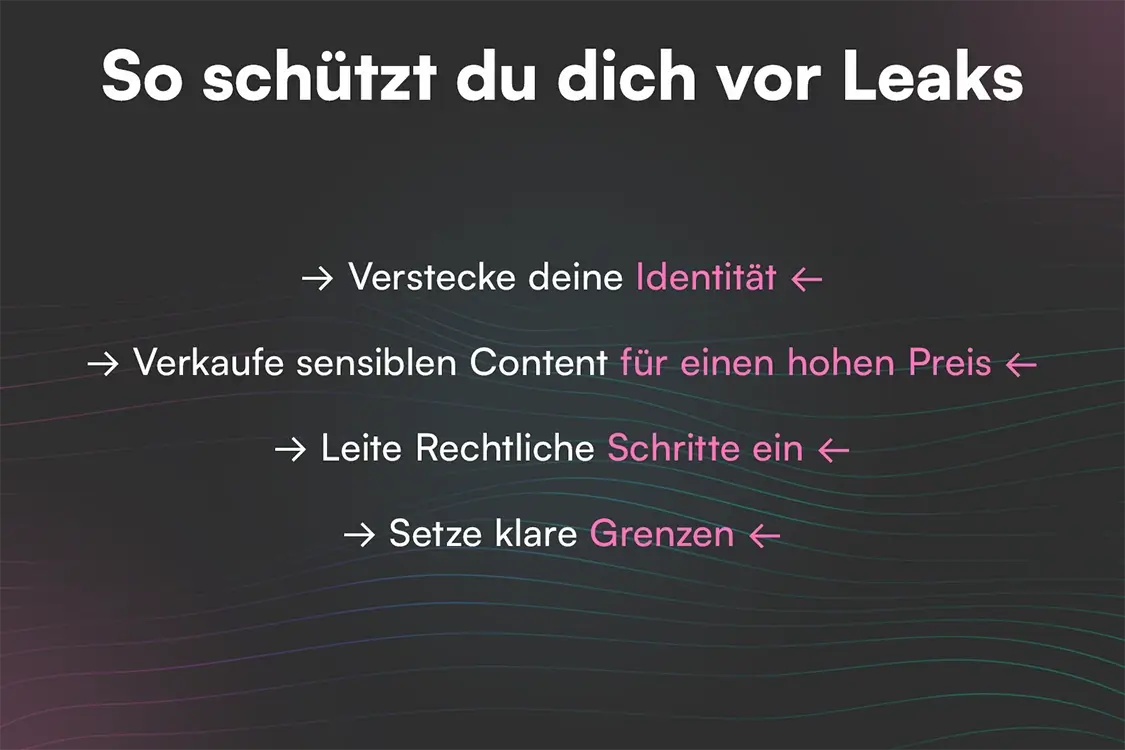
Summary: stay calm, work the process
Leaks are a real risk on OnlyFans, but not the unknowable threat they are often made out to be. In our portfolio we see that clean prevention (watermarking, geo-block, environment hygiene) catches the bulk of cases, and that when something does slip through, there is a clear takedown and legal path that kicks in within a few days. Panic is the worst companion in either phase.
Working with a specialist agency means monitoring, takedowns and legal escalation do not sit entirely on the creator's shoulders. We are not a law firm, but we take on the operational load and have reliable contacts in UK and EU jurisdictions when matters need to go further.
Lukas helps creators grow successfully on OnlyFans.
YouTube