OnlyFans Explained: How the Platform Actually Works
- What is OnlyFans? A subscription and direct-sales platform. Fans pay monthly for feed access, or one-off for individual clips, messages and tips. OnlyFans keeps 20%, the creator keeps 80%.
- The subscription is the ticket, not the show. Across the accounts we manage, over 80% of revenue is made in the DMs — PPVs, custom clips, tips. The subscription itself contributes around 7%.
- There is no discovery algorithm. OnlyFans sends you almost no fans of its own. Traffic comes from Instagram, TikTok, Reddit or X and gets converted on the profile, which is why so many accounts stall at 50 subscribers.
- What can you realistically earn? Widely cited analyses put the median creator at roughly $150–200 a month. The distribution is extremely skewed, so that median says more about how many accounts sit unmanaged than about the ceiling.
- Tax applies from the first pound you earn. Any regular creator income has to be declared; in the UK that means registering with HMRC as a self-employed sole trader, with VAT only mandatory above £90,000 turnover. Rules differ by country, and none of this is tax advice.
What is OnlyFans, really? Not the tabloid version, but the operational reality from an agency running more than 20 creator accounts. We manage profiles that range from first-month beginners up to a documented case with $352,000 in a single month, and every day we see what the platform really is: a direct sales channel between a creator and a paying fan, without the algorithm lottery and without middlemen.
This article explains OnlyFans from A to Z. How the platform works, which features actually generate revenue, who uses it, how much you can realistically earn, and what the legal picture looks like. No numbers pulled from marketing brochures, only what we measure inside our own portfolio.
What Is OnlyFans and How Does It Work?
OnlyFans is a subscription and direct-sales platform for creators. Every creator gets a profile with a feed, a DM inbox, a store and a livestream tool. Fans either pay monthly for a subscription or one-off for individual content (pay-per-view), messages and tips. OnlyFans keeps 20% of the revenue and the remaining 80% goes to the creator.
The decisive difference compared to Instagram, TikTok or YouTube: there is no discovery algorithm. OnlyFans itself brings you almost no new fans. Traffic comes from outside (Instagram, TikTok, Reddit, X) and is converted on OnlyFans. Anyone who misses this point stalls at 50 subscribers. Anyone who gets it, scales.
The workflow in three lines
- Creator side. Build the profile, verify your identity, set a price, post content, message fans, collect the revenue.
- Fan side. Find a profile, buy the subscription or redeem a trial link, consume exclusive content, chat with the creator (or the chat team) in DMs, unlock paid content.
- Platform side. OnlyFans hosts the content, handles payments, and provides the tools for messaging, livestreams, promos and analytics. 20% platform cut, 80% to the creator.
Which Features Actually Generate Revenue?
DMs and PPVs — in our portfolio they carry more than 80% of revenue, while the subscription barely registers. OnlyFans is not a single product but five layered monetisation tools, and most newcomers think "subscription" and ignore the rest. The table below shows what each feature is and where the money actually lives.
| Feature | What it is | Revenue share in the portfolio |
|---|---|---|
| Subscription | Flat monthly price (typically $5–20) for feed access | ~ 7%, entry funnel |
| PPV (Pay-per-View) | Individually priced content sold via DM or feed drop | Main revenue driver |
| Tips | Voluntary contributions, from $1 up to thousands per tip | ~ 10%, indicator of loyalty |
| Messages (DMs) | 1-to-1 chat, the vehicle for PPVs, tips and customs | Vehicle for > 80% of revenue |
| Livestream | Live broadcast with a tip goal, usually 45–90 minutes | Retention lever, not a revenue lead |
The split is the single most useful insight for anyone trying to understand OnlyFans: the subscription is the ticket, not the show. The show happens in the DMs, where chatters (or the creator themselves) get to know the fan and sell them tailored content. Treat OnlyFans as nothing more than a "photo subscription shop" and you are collecting 7% of the revenue that is actually available.
Who Uses OnlyFans? Creators and Fans
On the creator side, adult content is the largest share but far from the only one. We manage accounts across several niches, and on the platform itself you will also find fitness coaches, musicians, artists, and the occasional museum running digital exhibitions. What they all share is the same motivation: earn directly from their community, without the advertising middleman.
On the fan side, the audience is international, heavily male, and distributed along purchasing power. The US, UK, Germany, Australia and Canada are the strongest paying markets. A UK-based account writing in English can easily end up with 60–80% US fans — the pattern we see across our own accounts — because that's where spend is highest and where chat teams need to be reachable around the clock (ours respond in under 60 seconds).
How Do You Set Up an OnlyFans Account?
In seven steps: register, confirm your email, build the profile, verify your identity, add bank details, set a price, upload your first content. Signing up is the easy part. What matters is what happens afterwards, once the profile and the traffic plan are actually in place. Here is the condensed version of the setup.
- Register. Go to onlyfans.com and sign up with email, Google or X. Pick the username carefully because it becomes your URL.
- Confirm your email. Standard verification link.
- Build the profile. Profile picture, banner and bio. All three in a consistent visual language. Three elements, one message.
- Verify your identity. Government ID plus a selfie with the ID. Review usually completes in 24–48 hours.
- Add bank details. No payout channel means no monetisation.
- Set your price. For beginners we recommend a list price of $10 with a permanent promo of around 70% off — effectively about $3 at entry. That converts far better than a flat $3 list price.
- Upload your first content. At least 10–15 feed posts before you accept the first paying subscriber, otherwise the profile looks empty.
Do You Need to Register a Business and Pay Tax?
Yes, from the first pound. As soon as you earn money on OnlyFans, HMRC treats you as a self-employed sole trader (or, above certain thresholds, as someone who needs to incorporate or register for VAT). HMRC doesn't distinguish between "hobby creator" and "full-time creator". Any regular income has to be declared. Tax rules vary by country, so always verify your own obligations, but the UK picture looks roughly like this.
Registering as self-employed
- Where. Register with HMRC as a sole trader through your Government Gateway account.
- Cost. Free to register. You pay tax on profit, not on registration.
- Trade description. Sensible options include "online content creation", "digital services" or "model".
- What follows. An annual Self Assessment return, with National Insurance contributions triggered on top of income tax.
Types of tax
- Income tax. Applied to your profit along standard UK bands.
- National Insurance. Class 2 and Class 4 contributions kick in above the relevant small-profits threshold.
- VAT. Mandatory once your taxable turnover crosses the VAT threshold (currently £90,000). Under that, registration is voluntary.
A practical observation from our portfolio: creators who bring in a specialist accountant early usually save four- or five-figure sums in the first two years by claiming the right expenses (cameras, lighting, outfits, travel, agency fees). The DIY spreadsheet approach tends to end in catch-up bills.
How Do Creators Actually Make Money?
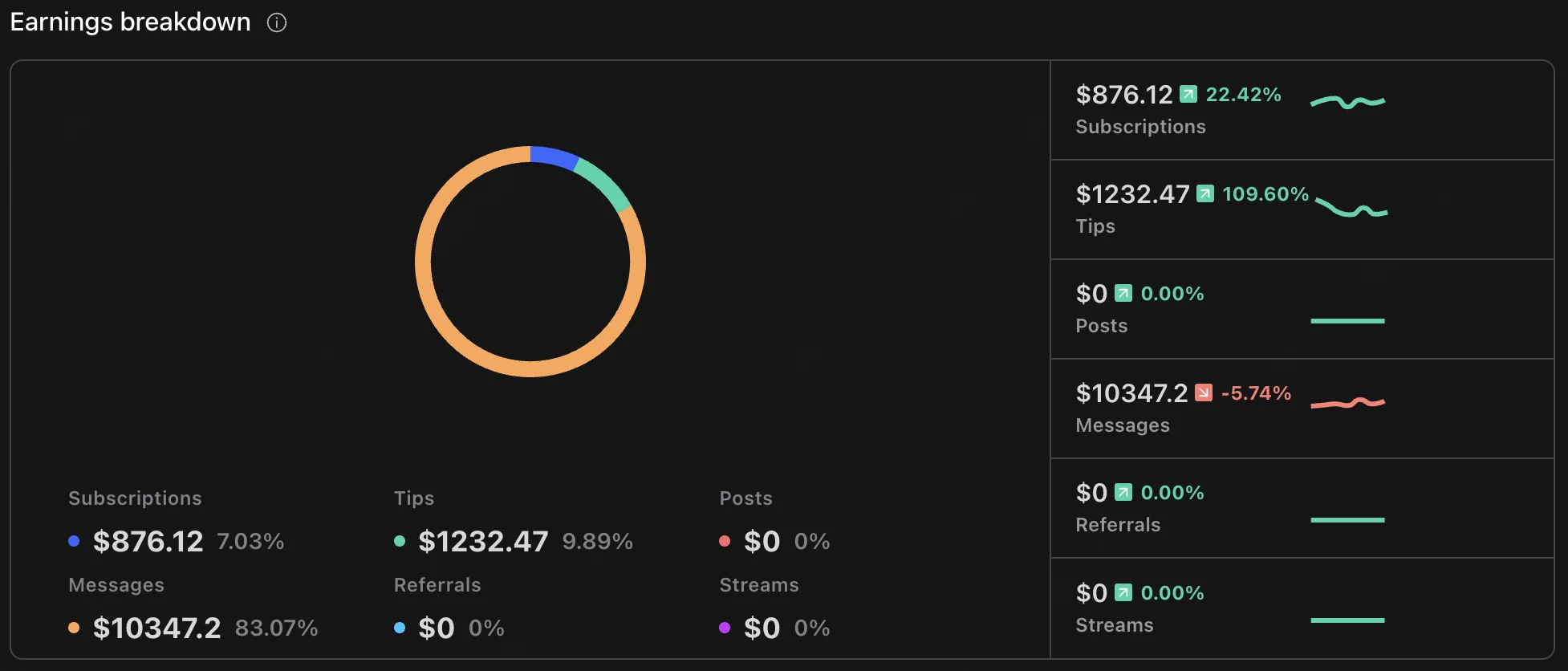
In the DMs, overwhelmingly — not through subscriptions. The standard story about OnlyFans goes like this: "Subscription costs X, times Y subscribers, equals Z per month." That maths does not fit a single account we manage. The actual revenue split inside our portfolio:
- Over 80% of revenue from DMs. PPV sales, custom clips, voice notes and tips in the DM. This is the real work and the point where a strong chat team makes the difference.
- Around 10% from tips. Spontaneous contributions, often during livestreams or as a response to specific content. Scales with loyalty.
- About 7% from subscriptions. The subscription fee is an entry price for most fans, not the final price. Bundles (3-month, 6-month) stabilise retention.
Two structural factors drive revenue further: whales and response time. In our portfolio, the top 1% of paying fans on an account generate around 15% of monthly revenue. We re-engage those whales every couple of days so they do not churn out. Sit above 60 seconds response time and even the "normal" fans start to drop off.
More detail on this in Maximising Your OnlyFans Income.
What Are the Real Opportunities and Risks?
OnlyFans is neither a gold rush nor a trap. It is a business model with real upside and real downside. Honestly listed:
Opportunities
- Full control over content and price. No advertising partners, no platform censorship beyond the published guidelines.
- Direct revenue per fan. 80% of the gross goes to the creator, far above the fractions in ad-funded models.
- Freedom of location. Camera, lighting and a working routine are all you need.
- Not tied to one algorithm. Creators who build outside traffic across several channels are not one TikTok update away from disaster.
Risks
- Stigma. Especially in adult niches. Family, friends and future employers respond in different ways. Anonymity is possible but never fully guaranteed.
- Platform dependency. An account ban means zero revenue. Backup channels (mailing list, off-platform community) are a must.
- Content leaks. No platform is fully leak-proof. OnlyFans offers DMCA tools that work, but they cannot undo what is already out.
- Tax and legal admin. Underestimated, especially during rapid growth. A missed quarter can get expensive.
- Workload. A serious account is a full-time job. Shooting, editing, posting, DMs, social promotion, analytics. Anyone doing all of that alone burns out inside 3–6 months.
How Did OnlyFans Become the Market Leader?
Through 2020: lockdowns, home working and a sudden rush of people needing digital income turned a Patreon-style niche tool into the default platform for paid content. OnlyFans was founded in 2016 in the UK by Tim Stokely. The original idea was a creator platform along Patreon lines, open to any niche. The adult industry quickly spotted the potential: free pricing, direct fan contact and a fair revenue share.
The scale of that jump is easy to underestimate. By the end of 2020, OnlyFans already counted over a million creators and more than 90 million registered users — historical figures that have long been overtaken: per the platform's own fiscal-2024 filing (Fenix International, year ending November 2024), OnlyFans now reports over 377 million registered fan accounts and more than 4.6 million creator accounts. It has stayed the market leader for paid direct content ever since, with a growing share of non-adult creators but a clear dominance in the adult space.
Frequently Asked Questions About OnlyFans
Is OnlyFans only for adult content?
No. The majority of platform revenue does come from adult content, but fitness, music, cooking, coaching and art are all explicitly permitted. The platform rules prohibit illegal content, depictions of minors, and certain extreme categories. Everything else is allowed as long as it fits the general terms.
What percentage does OnlyFans keep?
20%. The creator is paid 80% of the gross after payment fees. That is generous compared to other content platforms (YouTube takes 45%, traditional studios often 50–70%).
Can you work on OnlyFans anonymously?
Yes, with limits. Face, tattoos and other identifying features can be kept out of the content. The ID verification is purely internal, and only the public creator profile is visible. Full anonymity needs discipline, though: social accounts, traffic sources and filming environment all have to stay consistently anonymous.
How much does the average creator earn?
The average is misleading because the distribution is extremely skewed. Widely cited analyses — originally based on 2020 platform data and still quoted in 2026 industry statistics — put the median creator income at roughly $150–200 per month. Across the accounts we manage, average spend per paying fan sits around $30–40 per month, and the top 1% of fans on an account drive around 15% of its revenue. What matters is not the "average" but the operational setup of the individual account.
Do I need an agency for OnlyFans?
For the first $500–1,000 per month, no. Once the DMs stop being manageable solo (typically at 1,000–2,000 paying fans or $10,000+ monthly revenue), a professional chat and promo setup becomes operationally necessary. Anyone aiming for five- or six-figure months does not get there without a team.
Conclusion: Is OnlyFans Worth It in 2026?
In 2026 OnlyFans is by some distance the most direct way to turn a content community into real monthly revenue. The platform has been on the market since 2016, payments and infrastructure are solid, and the legal picture in most jurisdictions is workable.
It is realistic for anyone willing to produce content, build outside traffic, work the DMs consistently and sort the tax side. It is unrealistic for anyone who believes that a profile and a handful of selfies will land them in five-figure territory. The gap between "okay" and "strong" isn't the content, it's the structure behind it.
If you are serious about starting or about lifting an existing account, talk to us. MAHO Management currently looks after more than 20 creators and knows the operational reality described here from first-hand portfolio work. Not a generic course, just direct work on your account.
Book a call today to discuss our OnlyFans account management and put your launch on a structure that holds up.

Lukas helps creators grow successfully on OnlyFans.
YouTube